I am a multisensory perception scientist
working across fundamental and applied research.
I investigate how the senses interact to generate a
coherent representation of our bodies and the environment,
and how this information guides action.
My research combines psychophysics with
ideal observer and stimulus-computable models of
multisensory perception and action.
A central strand of this work is the
Multisensory Correlation Detector,
a biologically inspired model that predicts audiovisual
perception directly from sensory input.
This research aims to explain the computations linking
sensory signals to perceptual experience, behaviour
and neural responses.
I apply this understanding to the development of
immersive technologies and sensory augmentation.
Previously, I worked as a research scientist and
principal investigator at
Meta Reality Labs,
investigating haptics, multisensory integration and
spatial audio for virtual and augmented reality.
I work with hardware and software engineers on interface
design, algorithm development and quantitative
perceptual evaluation.
My applied projects include algorithms that localise
sound sources in video and generate spatial audio
for films with non-spatial soundtracks.
I have also developed SonicWhiskers,
a sensory substitution system that converts optical
input into auditory and haptic feedback.
The aim is to help blind and partially sighted people
access information about their surroundings and to
extend perception when vision is unavailable.
I welcome enquiries about
research collaborations and applied projects,
including perceptual evaluation, computational
modelling and interface development.
Education
DPhil in Experimental Psychology
University of Oxford
Laurea in Psychology
University of Milano-Bicocca
Editorial roles
Associate Editor for
ACM Transactions on Applied Perception
Multisensory Research
Frontiers in Human Neuroscience
Selected awards
2014 ·
Attempto Prize
University of Tübingen — for research on natural auditory
scene statistics and spatial hearing.
2013 · National Award for Best PhD Thesis
Italian Association of Psychology (AIP) Experimental Psychology Section
My research investigates how the brain processes and combines
information from vision, hearing and touch to perceive our bodies
and surroundings and guide action. I combine psychophysics,
computational modelling and neuroscience to understand the
principles of sensory perception, with applications in immersive
technologies and sensory augmentation.
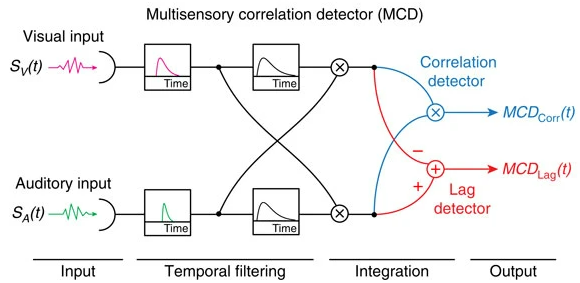
Multisensory Correlation Detector (MCD), a biologically
inspired model for multisensory integration.
Parise & Ernst (2016), Nature Communications.
Multisensory integration
All animals, even the simplest ones, rely on multiple sensory
systems to perceive their bodies and surroundings.
My research investigates the computational principles
governing multisensory integration, with particular emphasis
on vision and audition.
A central question is how the brain determines which sensory
signals originate from a common source and should therefore
be integrated. I address this question through psychophysics
and stimulus-computable models, with applications ranging
from sensory substitution to artificial perception and
augmented reality.
Selected publications
Parise, Parise & Parise (2026).
Perceiving audiovisual synchrony: A quantitative synthesis
of simultaneity and temporal order judgments from 185 studies.
Neuroscience & Biobehavioral Reviews.
Parise (2025).
Correlation detection as a stimulus computable account
for audiovisual perception, causal inference, and saliency
maps in mammals.
eLife.
Parise & Ernst (2025).
Multisensory integration operates on correlated input
from unimodal transient channels.
eLife.
Pesnot Lerousseau et al. (2022).
Multisensory correlation computations in the human brain
identified by a time-resolved encoding model.
Nature Communications.
Parise & Ernst (2017).
Noise, multisensory integration, and previous response
in perceptual disambiguation.
PLOS Computational Biology.
Parise & Ernst (2016).
Correlation detection as a general mechanism for
multisensory integration.
Nature Communications.
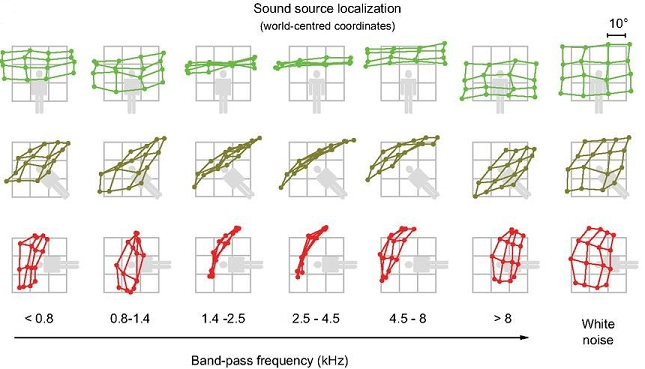
Frequency-induced biases in sound-source localisation,
illustrated by localisation responses across different
frequency bands.
Parise, Knorre & Ernst (2014), PNAS.
Spatial hearing
Unlike vision and touch, which rely on spatially organised
sensory receptors, the cochlea is organised primarily
according to sound frequency. Nevertheless, humans can
accurately localise sounds in their surroundings.
My research investigates the computational principles
of spatial hearing, including how acoustic cues and
natural scene statistics shape sound localisation,
how we perceive auditory motion, and how perceptual
learning allows us to adapt to unfamiliar acoustic
environments.
Selected publications
Parise et al. (2024).
Happy new ears: Rapid adaptation to novel spectral cues
in vertical sound localization.
iScience.
Senna, Parise & Ernst (2017).
Modulation frequency as a cue for auditory speed perception.
Proceedings of the Royal Society B.
Parise, Knorre & Ernst (2014).
Natural auditory scene statistics shapes human spatial hearing.
Proceedings of the National Academy of Sciences.
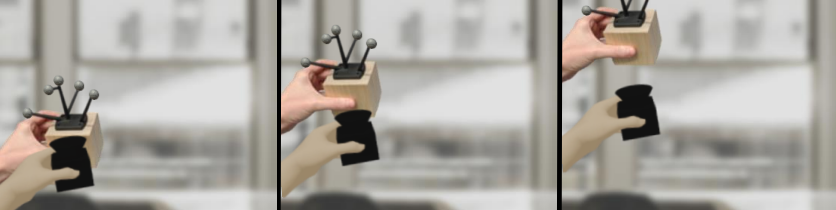
Pseudo-haptic weight: manipulating the control-display
ratio changes the perceived weight of virtual objects
without physical force feedback.
Samad et al. (2019), ACM CHI.
Touch and motor control
Our hands are our primary means of interacting with
the environment. Touch and proprioception provide
information about objects and our own movements,
contributing to both perception and action.
My research investigates how tactile information
contributes to manual interactions and how multisensory
integration can compensate for impoverished haptic
feedback. A particular focus is the development and
evaluation of perceptually informed interfaces for
virtual and augmented reality.
Selected publications
Ryan et al. (2021).
The interaction between motion and texture in the sense of touch.
Journal of Neurophysiology.
A biologically inspired model that turns images and sounds into predictions of what we perceive—and where we look.
One mechanism. Many perceptual effects.
When someone speaks, their movements and voice change together. The Multisensory Correlation Detector (MCD) uses this shared structure to connect information across the senses.
Rather than starting with a description of a stimulus, the model processes the stimulus itself. From pixels and audio samples, it generates predictions about audiovisual timing, cue integration, perceptual illusions and attention. [1]
The recorded conversation is shown above the model’s correlation map; coloured markers show measured gaze. The model highlights the active speaker without face recognition or speech recognition. Demonstration accompanying Parise (2025), using footage and eye-tracking data from Coutrot & Guyader (2015).
69experiments simulated
3 specieshumans, rats and monkeys
>0.97reported mean model–data correlation
Results reported in the 2025 population-model paper. Correlation measures agreement with the data, not percentage accuracy. The model shares its sensory architecture across tests; task-specific parameters and species-specific temporal tuning are described below. [1]
Multisensory research has been strongly shaped by ideal-observer models, particularly maximum-likelihood estimation and Bayesian causal inference. In David Marr’s terms, these are primarily computational-level accounts: they explain the goals of perception, such as obtaining reliable estimates and deciding which signals belong together.
Their success leaves an important question open. How are these computations performed on the sensory stream? The influential cue-integration models typically begin with quantities such as location, reliability or audiovisual delay. Biological systems must first extract useful information from changing light and sound.
The MCD addresses this algorithmic gap by making the intermediate representations and transformations explicit. It does not reject the achievements of Bayesian models: it asks how behaviour consistent with those accounts can emerge from elementary operations on sensory signals. [1]
01Images & soundsThe sensory input
02Detect changesTransient sensory responses
03Compare the sensesCorrelation and relative lag
04Read out the responsePerceptual decisions or saliency
Statistical optimality
MLE and Bayesian causal inference explain a lot — but they start later in the computation
Maximum-likelihood estimation (MLE) explains why two sensory cues are often combined in proportion to their reliability. Bayesian causal inference (BCI) explains why that integration weakens or breaks down when the cues are too discrepant, by weighting fusion against the probability that the signals arise from a common cause.
These frameworks are central to modern multisensory research and the MCD is meant to complement them, not replace them. Their main limitation is that they typically operate on experimenter-defined variables — such as cue location, audiovisual delay, cue reliability and their probability distributions. Real perceptual systems do not receive those abstractions. They receive patterns of light and sound, and must infer those quantities from the sensory stream.
The MCD works one step earlier. It operates on signals and their processing: images, sounds, and the changing structure they share over time and space. From a scientific perspective, this means that the problem it solves is closer to the one biological perceptual systems actually face. A further consequence is breadth: the same model that reproduces MLE-like cue combination and BCI-like segregation can also be run on realistic audiovisual scenes, such as a real ventriloquist performance, where classical parametric models do not directly operate. [1]
What statistically optimal models usually take as input
Estimated cue locations, lags, or intensities
Reliability terms and probability distributions
A decision about whether to integrate or segregate cues
What the MCD takes as input
The actual audiovisual signals: frames, pixels, waveforms and transients
Local computations of correlation and relative lag over space and time
Read-outs from which MLE-like integration, BCI-like behaviour and saliency can emerge
In the 2025 population-model paper, the spatial population of MCD units reproduces the classic signatures associated with MLE and BCI, while also extending naturally to realistic, dynamic material. This is the bridge between ideal-observer theory and stimulus-computable modelling. [1]
The mechanism
A familiar circuit, a different question
The starting point is the Hassenstein–Reichardt detector, a classic model of motion vision. It compares signals from neighbouring visual locations after delaying one relative to the other. Its component operations have been studied extensively in insect neuroscience, providing a physiologically grounded starting point rather than an arbitrary mathematical construction.
We adapted this principle to compare inputs across senses rather than across neighbouring points in an image. Two complementary outputs indicate how strongly the signals are correlated and which modality leads. Temporal filtering and simple interactions between signals make both outputs evolve continuously over time. [4]
The research programme is a test of sufficiency: how much of multisensory perception can this minimal, biologically plausible mechanism explain? The aim is not a separate model for every illusion, but a shared processing architecture tested against different stimuli, tasks and measures.
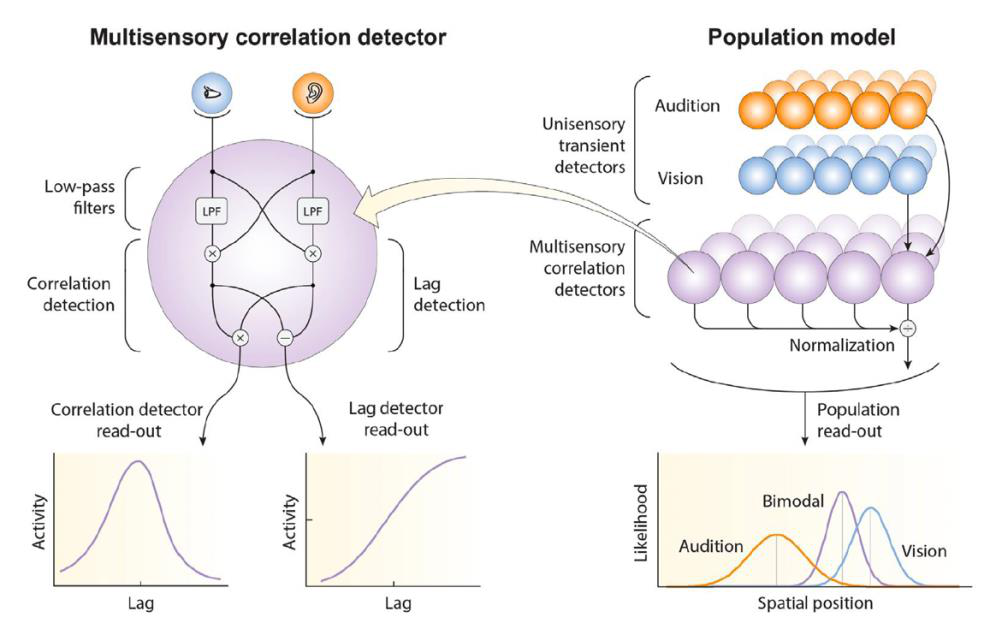
From a local computation to a population. Left: a detector provides correlation and lag read-outs. Right: spatially arranged detectors combine input from auditory and visual transient channels; normalisation supports a population estimate of location. Original artwork from Parise (2026), Figure 1. [7]Watch the original detector in action
The original MCD’s two outputs change as the relative timing of the inputs changes. Correlation is strongest near alignment; the lag signal distinguishes which sense leads. This silent animation accompanies Parise & Ernst (2016); later work refined the input stage to detect unsigned transients. [4]
The research programme
Evidence, not just a plausible circuit
2012–2013
Correlation matters beyond coincidence
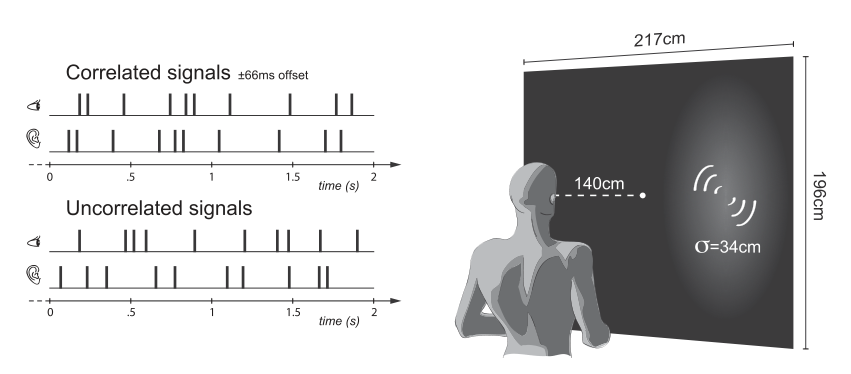
Before developing the model, we tested whether the fine temporal structure of audiovisual signals affects integration. In a localisation task, the gain in precision matched the prediction for optimal integration only when the signals were temporally correlated—even though they occupied the same physical location in both conditions. A subsequent study showed the complementary cost: correlated signals made spatial discrepancies harder to detect. Correlation therefore promotes binding, not simply better performance on every task. [2][3]
From the 2012 study. Correlated and uncorrelated audiovisual sequences were compared using the same localisation task. This was the empirical starting point for the correlation-based framework. Figure 1 from Parise, Spence & Ernst (2012). [2]
2016
Predicting a percept, not recovering a label
The first MCD was tested with independently generated, random sequences of clicks and flashes. Observers judged whether the streams seemed to share a cause and which seemed to lead. These sequences did not supply a uniquely defined correct classification for the two streams as a whole. Success therefore required matching the stimulus features that shaped human judgements—not merely recovering an experimenter-assigned answer. Given the same sequences, the MCD reproduced the observed classification patterns. [4]
2022
Testing the computations against brain activity
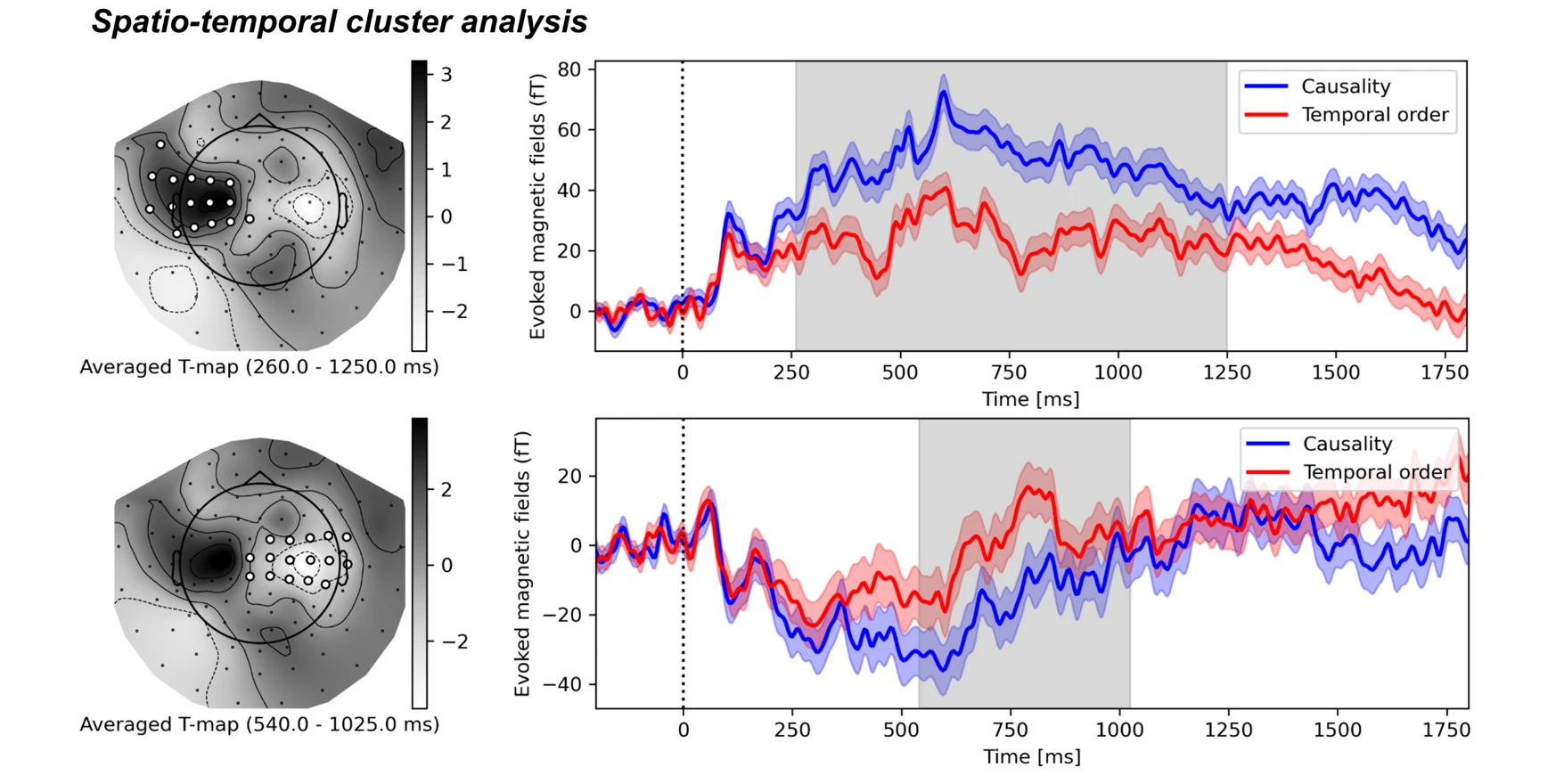
In a magnetoencephalography (MEG) study, participants judged audiovisual sequences while their brain activity was recorded. A time-resolved encoding analysis linked the MCD’s dynamics to temporo-parietal responses. Correlation-related signals were evident across tasks; lag-related evidence was more task-dependent. This connects a model of behavioural judgements to the unfolding neural computations, rather than only to a final response. [6]
The link to brain activity. A simple summary figure from the MEG paper: MCD-related dynamics predict task-relevant neural activity and help localise its cortical sources. Figure 3 from Pesnot Lerousseau et al. (2022). [6]
2025
What enters the detector? Changes, not sustained intensity
Two psychophysical experiments identified the importance of unsigned transients: changes in a signal, regardless of whether its intensity rises or falls. This matters because a shared event need not make light and sound intensities change in the same direction. The relevant evidence can be that something changes in both senses at the same time.
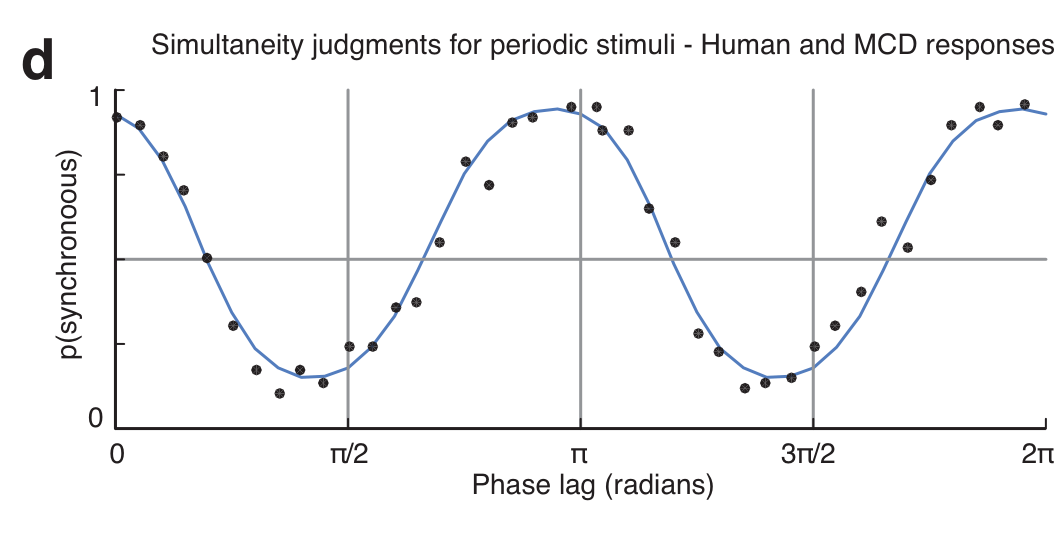
A striking prediction follows. For periodically modulated stimuli, both onsets and offsets provide matching events. Perceived synchrony can therefore peak twice within one stimulus cycle—when the signals are in phase and when they are half a cycle apart. Observers showed this frequency-doubling effect, and the transient-based MCD reproduced it. [5]
Two synchrony peaks, one mechanism. Dots: human judgements. Curve: MCD responses. The endpoints repeat the same phase; the second distinct maximum occurs halfway through the cycle. Cropped from Parise & Ernst (2025), Figure 5d. [5]
The population model
From clicks and flashes to natural audiovisual scenes
A single detector compares two signals over time. A lattice of detectors extends the same operation across space: each unit compares local visual changes with auditory input. With spatialised sound, the sensory inputs have aligned receptive fields; with a mono soundtrack, the auditory envelope is shared across image locations. The architecture does not require lateral message-passing between detector units; a population normalisation is used for spatial estimation.
This makes the model image- and sound-computable. It can process the footage used in an experiment, rather than being supplied only with its nominal audiovisual delay or spatial discrepancy. The 2025 study tested this architecture across 69 experiments, spanning seven behavioural tasks and data from 534 humans, 110 rats and two monkeys. [1]
Time
Synchrony and temporal-order judgements, temporal adaptation, and the dependence of audiovisual speech illusions on timing.
Space
Reliability-weighted cue combination, the ventriloquist effect, and the integration or segregation of signals described by Bayesian causal inference.
Attention
Audiovisual saliency maps that identify correlated regions of a scene and predict the distribution of gaze during natural viewing.
The important result is not just the number of successful fits. The same low-level computations connect effects usually studied in separate paradigms. MLE-like cue integration and BCI-like segregation emerge from a shared sensory mechanism, rather than from independent explanations for each phenomenon. Because the model runs on audiovisual stimuli themselves, the scientific model and a practical device are working on the same kind of representation: real signals in time and space. [1]
What was fitted, and what does the model not claim?
The population study estimated a common set of temporal-filter constants jointly across human timing experiments, with a separate, faster tuning for rats. These constants were then held fixed across additional tests. Depending on the simulation, 0–4 further parameters described task read-out or spatial uncertainty; the gaze analysis required no additional fitted parameters. The model is therefore not wholly parameter-free, and the reported mean correlation is not a held-out accuracy score for every experiment.
The speech simulations explain how audiovisual timing affects integration and the incidence of an illusion, not how a phoneme or word is recognised. The model does not currently include linguistic knowledge or top-down expectations. Its breadth is demonstrated over the tested studies, not over every possible audiovisual phenomenon. [1]
See the computations
Illusions without a specialised illusion mechanism
These demonstrations show the model’s responses to the audiovisual material itself. No face detector, lip tracker or speech recogniser is needed to compute the maps. Play with sound to experience the stimuli; browser playback is illustrative, not a calibrated psychophysical test. [1]
When seeing changes hearing
The McGurk illusion. Mismatched lip movements and speech can change the syllable a listener reports. As audiovisual delay varies, the model’s correlation response changes with the likelihood of integration. The response concentrates around the mouth without recognising it as a mouth. The model predicts the timing dependence of the effect, not phoneme identity. Demonstration accompanying Parise (2025).
When sound follows a visual source
The ventriloquist effect. The upper panel shows the scene; the panels below show the spatial and temporal distribution of correlation. The response follows the visual source whose movements match the soundtrack, including the dummy. It does not need to understand the performance. The dummy’s voice was pitch-shifted in post-production. Demonstration accompanying Parise (2025).
A closer look: the response to natural speech
The video, correlation map and lag map are shown side by side. Traces below show the stimuli, transient responses and detector outputs as the audiovisual delay changes. This makes the intermediate processing visible, not just the final prediction. Demonstration accompanying Parise (2025).
An unexpected test
Synchrony with distance without explicitly calculating distance
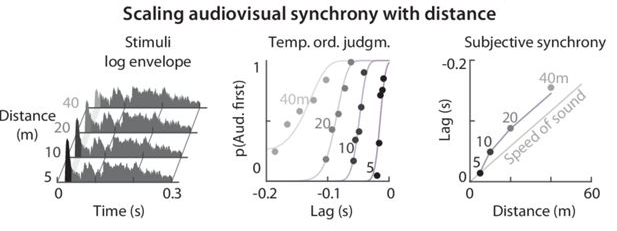
Sound takes longer than light to reach an observer. In a classic experiment, Alais & Carlile (2005) found that subjective audiovisual alignment shifted with perceived source distance, approximately as expected from sound propagation. The result was interpreted in terms of estimating distance and compensating for the associated acoustic travel time. [8]
The MCD reproduces this shift without an explicit distance estimate or a stored speed of sound. The explanation lies in the auditory envelope: in the tested reverberant stimuli, increasing distance weakens the direct onset relative to the reverberant tail. The sound becomes less front-loaded, changing the evidence received by the lag detector.
Scaling audiovisual synchrony with distance. The 2025 paper shows, side by side, the distance-dependent stimulus envelopes, the psychometric curves, and the resulting shift in subjective synchrony. The key point is that the scaling emerges from changes in the auditory signal itself. [1]
Stimuli
Click envelopes recorded at different apparent distances
The reverberant tail stays the same
The direct onset weakens with distance
Psychometric curves
Empirical and predicted synchrony curves are shown for each distance
All four curves share the same decision parameters
The separation across curves comes from the signal waveform
Scaling result
The point of subjective synchrony shifts systematically with distance
The shift scales approximately with the speed of sound
The MCD reproduces this trend from the stimulus structure alone
In the stimulusDirect onset weakens relative to the reverberant tail
In the detectorThe temporal balance of sensory evidence shifts
In the predictionThe point of subjective alignment shifts
All four distance conditions were fitted with one shared set of decision parameters, while the temporal filters were held fixed. The separation between the curves therefore arose from the stimulus waveforms, not a different delay correction fitted to each distance. [1]
The broader lesson: structure already present in a sensory signal can support behaviour that appears to require an explicit physical calculation.
The 2025 paper shows these three components together: the distance-dependent click envelopes, the corresponding psychometric curves, and the final scaling of subjective synchrony with distance. This demonstrates a sufficient signal-based explanation of the tested effect; it does not imply that the brain never represents distance. See Figure 2B for the full stimuli and plots.
From a scientific model to applied research
Applied perception projects
This section is an invitation to collaborate on applied perception projects. Because the model operates directly on audiovisual signals, it can be used to analyse the same kinds of inputs that devices produce and users experience. Instead of specifying an abstract audiovisual mismatch, we can present the model with the actual content, inspect its intermediate responses, and ask how particular design choices might affect perception.
Perceptual evaluation & immersive interfaces
Use stimulus-specific predictions to investigate audiovisual timing, binding and salience in recordings or prototypes. The model can guide experimental comparisons and help identify which signal features drive a perceptual effect.
Audiovisual localisation & spatial audio
Explore correspondence maps for associating sounds with visible sources. This offers a foundation for bespoke algorithms in audiovisual media, spatial audio and systems that must orient towards relevant events.
Interpretable multimodal AI & robotics
A high response has a concrete explanation: local auditory and visual changes are correlated. Such a module could provide correspondence-based supervision for learning from unlabelled video, or an inspectable sensory front end for a larger system.
These directions follow from the model’s demonstrated ability to process audiovisual signals and generate interpretable correspondence maps. This matters for industry because the model and a practical application operate on the same kind of representation: the images and sounds delivered by devices and encountered by users. Its simple, local operations also motivate investigation of efficient implementations. Improved learning efficiency, real-time device performance and benefits in a particular product remain questions to test, not results established by the existing experiments. [1]
Interested in an applied perception collaboration?
I welcome collaborative R&D, bespoke algorithm development and model-based perceptual evaluation for immersive technologies, audiovisual systems, assistive technologies and multimodal machine perception.
Correlation detection as a stimulus computable account for audiovisual perception, causal inference, and saliency maps in mammals
The population architecture, the 69-experiment evaluation, natural-scene demonstrations, assumptions and limitations. Full methods and MATLAB source code accompany the article.
Peer-reviewed articles, book chapters, and dissertations.
Full-text copies of my publications are freely available on
ResearchGate.
2026
ArticleParise, C., Parise, E., & Parise, A. (2026). Perceiving audiovisual synchrony: A quantitative synthesis of simultaneity and temporal order judgments from 185 studies. Neuroscience & Biobehavioral Reviews, 106449.
ArticleParise, C. (2026). A new look at audiovisual perception: From correlation detection to a general theory of multisensory integration. The Cognitive Psychology Bulletin, (11).
ArticleDiederich, A., Otto, T., & Parise, C. (2026). Viewpoint on multisensory decision-making. Multisensory Research, 1 (aop), 1–11.
2025
ArticleParise, C. (2025). Correlation detection as a stimulus computable account for audiovisual perception, causal inference, and saliency maps in mammals. eLife, 14, RP106122.
ArticleParise, C., & Ernst, M. O. (2025). Multisensory integration operates on correlated input from unimodal transient channels. eLife, 12, RP90841.
2024
ArticleParise, C., Gori, M., Finocchietti, S., Ernst, M., Esposito, D., & Tonelli, A. (2024). Happy new ears: Rapid adaptation to novel spectral cues in vertical sound localization. iScience, 27(12).
PreprintParise, C. (2024). A stimulus-computable model for audiovisual perception and spatial orienting in mammals. bioRxiv.
PreprintParise, C. (2024). Spatiotemporal models for multisensory integration. bioRxiv.
2022
ArticlePesnot Lerousseau, J., Parise, C., Ernst, M. O., & van Wassenhove, V. (2022). Multisensory correlation computations in the human brain identified by a time-resolved encoding model. Nature Communications, 13, 2489.
2021
ArticleRyan, C. P., Bettelani, G. C., Ciotti, S., Parise, C., Moscatelli, A., & Bianchi, M. (2021). The interaction between motion and texture in the sense of touch. Journal of Neurophysiology, 126(4), 1375–1390.
2019
ArticleMoscatelli, A., Bianchi, M., Ciotti, S., Bettelani, G. C., Parise, C., Lacquaniti, F., & Bicchi, A. (2019). Touch as an auxiliary proprioceptive cue for movement control. Science Advances, 5(6), eaaw3121.
Conference paperSamad, M., Gatti, E., Hermes, A., Benko, H., & Parise, C. (2019). Pseudo-haptic weight: Changing the perceived weight of virtual objects by manipulating control-display ratio. CHI 2019, 1–13.
Conference paperde Grosbois, J., Di Luca, M., King, R., Parise, C., & Ziat, M. (2019). Exogenous cueing of visual attention using small, directional, tactile cues applied to the fingertip. IEEE World Haptics Conference, 455–460.
Conference paperde Grosbois, J., King, R., Di Luca, M., Parise, C., Bazen, R., & Ziat, M. (2019). The frequency of tactile adaptation systematically biases subsequent frequency identification. IEEE World Haptics Conference, 295–300.
2017
ArticleSenna, I., Parise, C., & Ernst, M. O. (2017). Modulation frequency as a cue for auditory speed perception. Proceedings of the Royal Society B, 284(1858), 20170673.
ArticleParise, C., & Ernst, M. O. (2017). Noise, multisensory integration, and previous response in perceptual disambiguation. PLoS Computational Biology, 13(7), e1005546.
2016
ArticleParise, C., & Ernst, M. O. (2016). Correlation detection as a general mechanism for multisensory integration. Nature Communications, 7, 11543.
ArticleParise, C. (2016). Crossmodal correspondences: Standing issues and experimental guidelines. Multisensory Research, 29(1–3), 7–28.
ArticleParise, C., Spence, C., & Deroy, O. (2016). Understanding the correspondences: Introduction to the special issue on crossmodal correspondences. Multisensory Research, 29(1–3), 1–6.
2015
ArticleSenna, I., Russo, C., Parise, C., Ferrario, I., & Bolognini, N. (2015). Altered visual feedback modulates cortical excitability in a mirror-box-like paradigm. Experimental Brain Research, 233(6), 1921–1929.
ArticleSenna, I., Parise, C., & Ernst, M. O. (2015). Hearing in slow-motion: Humans underestimate the speed of moving sounds. Scientific Reports, 5, 14054.
ArticleEverett, J. A. C., Schellhaas, F. M. H., Earp, B. D., Ando, V., Memarzia, J., Parise, C., Fell, B., & Hewstone, M. (2015). Covered in stigma? The impact of differing levels of Islamic head-covering on explicit and implicit biases toward Muslim women. Journal of Applied Social Psychology, 45(2), 90–104.
2014
ArticleParise, C., Knorre, K., & Ernst, M. O. (2014). Natural auditory scene statistics shapes human spatial hearing. PNAS, 111(16), 6104–6108.
ArticleSenna, I., Maravita, A., Bolognini, N., & Parise, C. (2014). The marble-hand illusion. PLoS ONE.
ChapterVan Dam, L. C. J., Parise, C., & Ernst, M. O. (2014). Modeling multisensory integration. In Sensory Integration and the Unity of Consciousness.
2013
ArticleParise, C., Harrar, V., Ernst, M. O., & Spence, C. (2013). Cross-correlation between auditory and visual signals promotes multisensory integration. Multisensory Research.
ChapterParise, C., & Spence, C. (2013). Audiovisual crossmodal correspondences in the general population. In The Oxford Handbook of Synesthesia. Oxford University Press.
2012
ArticleParise, C., Spence, C., & Ernst, M. O. (2012). When correlation implies causation in multisensory integration. Current Biology, 22(1), 46–49.
ArticleParise, C., & Spence, C. (2012). Audiovisual crossmodal correspondences and sound symbolism: A study using the implicit association test. Experimental Brain Research, 220(3), 319–333.
ArticleSpence, C., & Parise, C. (2012). The cognitive neuroscience of crossmodal correspondences. i-Perception, 3(7), 410–412.
ArticleParise, C., & Spence, C. (2012). Assessing the associations between brand packaging and brand attributes using an indirect performance measure. Food Quality and Preference, 24(1), 17–23.
ThesisParise, C. (2012). Signal compatibility as a modulatory factor for audiovisual multisensory integration. PhD thesis, University of Oxford.
2011 and earlier
ArticleParise, C., & Pavani, F. (2011). Evidence of sound symbolism in simple vocalizations. Experimental Brain Research, 214(3), 373–380.
ArticleSpence, C., & Parise, C. (2010). Prior-entry: A review. Consciousness and Cognition, 19(1), 364–379.
ArticleParise, C., & Spence, C. (2009). 'When birds of a feather flock together': Synesthetic correspondences modulate audiovisual integration in non-synesthetes. PLoS ONE, 4(5), e5664.
ArticleParise, C., & Spence, C. (2008). Synesthetic congruency modulates the temporal ventriloquism effect. Neuroscience Letters, 442(3), 257–261.
ThesisParise, C. (2006). Somiglianze crossmodali: Interazioni fra stimoli visivi ed uditivi. Laurea thesis.
Patents
US patents on perceptual and multisensory technologies.
Impedance shaping for haptic interfaces on wearable devices
US Patent No. 11,385,716 · 2022
Mukherjee, G., Shimasaki, K., King, R., Israr, A., Parise, C., Piazza, D., Samad, M. J., Gatti, E., & Corson, N. R.
I welcome opportunities to collaborate on fundamental research
and applied projects at the intersection of perception science,
neuroscience and technology.
Academic collaborations
I welcome collaborations in multisensory perception,
psychophysics and computational neuroscience, as well
as invitations for seminars, research visits and
interdisciplinary projects.
Prospective PhD students and postdoctoral
researchers are also encouraged to get in
touch to discuss potential projects, supervision
and funding opportunities.
Industry & applied research
I work with industry partners on perceptual evaluation,
computational modelling and interface development,
particularly in immersive technologies, spatial audio,
haptics and sensory augmentation.